
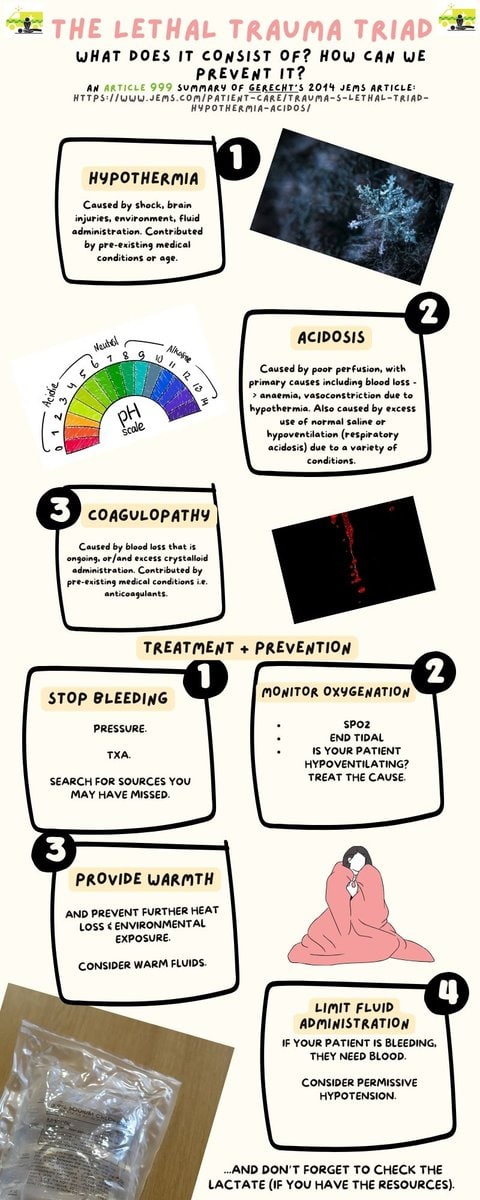
Tag: hypothermia
-

The Case of Anna Bagenholm
In 1999, Anna Bagenholm survived a cardiac arrest after a prolonged down-time and a temperature of just 13.7c. The circumstances of her survival continue to make international news and to inform and inspire research about target temperature management. There have been very few documented cases of survival from such extreme hypothermia, especially with minimal neurological impact. Consider the statistics on neurological impact from ordinary cardiac arrests, with less down-time, and Anna’s case becomes even more extraordinary. But does her survival mean we should target hypothermia in cardiac arrest patients? Should we target hypothermia in ROSC? Let’s have a look at the case and the research that has followed:
The case
Situation: 29 Year Old Female (Anna Bagenholm) is submerged head-first in a hole in the ice in a mostly frozen stream for 80 minutes.
Background: She has no medical history. She has slid down an icy slope while skiing with colleagues.
Assessment: She was conscious for the first 40 minutes, but has been unconscious for 40 mins since. After recovery, she is in cardiac arrest. Her ECG shows asystole. During the resuscitation attempt, the following is also learned:
- Temp: 13.7
- Pupils: dilated
She is warmed and the resuscitation team are watching an echo of her heart, which begins to move. ROSC was not gained until 4 ½ hours after she fell, and she spent 35 days on life support.
Questions: What would your expectations be of her ROSC management? What would your expectations of her survival and neurological impact be?
Recommendation — today:
- Maintain a target temperature at a constant value between 32°C and 36°C for at least 24 h.
- Avoid fever (> 37.7°C) for at least 72 h after ROSC in patients who remain in coma.
- Do not use pre-hospital intravenous cold fluids to initiate hypothermia.
(Resuscitation Council, 2021)
Decision/Outcome: Not only does Anna survive, her long-term neurological impact is minimal. Have a look at the video:
More Questions:
- What target temperature does your Trust follow for ROSC management? Do you think it should be lower, or higher, having seen Anna’s case?
- Do you think it’s possible to replicate the results of Anna’s treatment? What makes her situation so different to a cardiac arrest patient who has been treated with target temperature management?
The Research
Have a look at the results of some recent studies into target temperature management, below:
Year In or out of hospital study Presenting rhythm Targets Outcome 2002 OHCA Shockable 33 and 37 Positive for survival and neurological impact 2010 OHCA Shockable Cooled IV fluids (No target temperature listed) No difference 2013 OHCA Both shockable and non-shockable, but presumed cardiac cause 33 and 36 No difference 2014 OHCA Both shockable and non-shockable 2L of normal saline at 4 degrees, vs standard care No difference 2018 OHCA Shockable 32, 33, 34 No difference 2019 OHCA and IHCA Non-shockable 33 vs 37.5 Improved survival and good neurological outcome (CPC = 1 or 2) 2021 OHCA Presumed cardiac cause 33 vs 37.5 No difference Adapted from: Rasmussen and Girotra, 2021. Final discussion point:
Why can’t controlled studies replicate the kind of outcome that Anna had? Share your thoughts below, or on our Facebook or Twitter pages.
References (excluding videos and direct links above):
Rasmussen, T. P. and Girotra, S. 2021. A Contemporary Update on Targeted Temperature Management, Available at: https://www.acc.org/latest-in-cardiology/articles/2021/11/09/13/16/a-contemporary-update-on-targeted-temperature-management (Accessed 15/05/2022).
Resuscitation Council, 2021. Post-Resuscitation Care Guidelines, Available at: https://www.resus.org.uk/library/2021-resuscitation-guidelines/post-resuscitation-care-guidelines (Accessed 15/05/2022).
-
Tell me about the treatment of ischaemic CVAs
This post refers to treatment in hospital and the potential for future treatment pre-hospitally. Ischaemic CVAs are usually treated with thrombolysis using IV alteplase within 4.5 hours from symptom onset and after a CT scan and diagnosis, but there are new tests and treatments coming out and many other factors to consider.