Category: Job Role
-
End of Bed Assessment – 16 Reasons Your Patient is Pale
Here’s a list I’ve had for a while but not published: obvious, less obvious, and utterly surprising reasons your alive patient might be pale. References within. Detailed reference list coming soon.

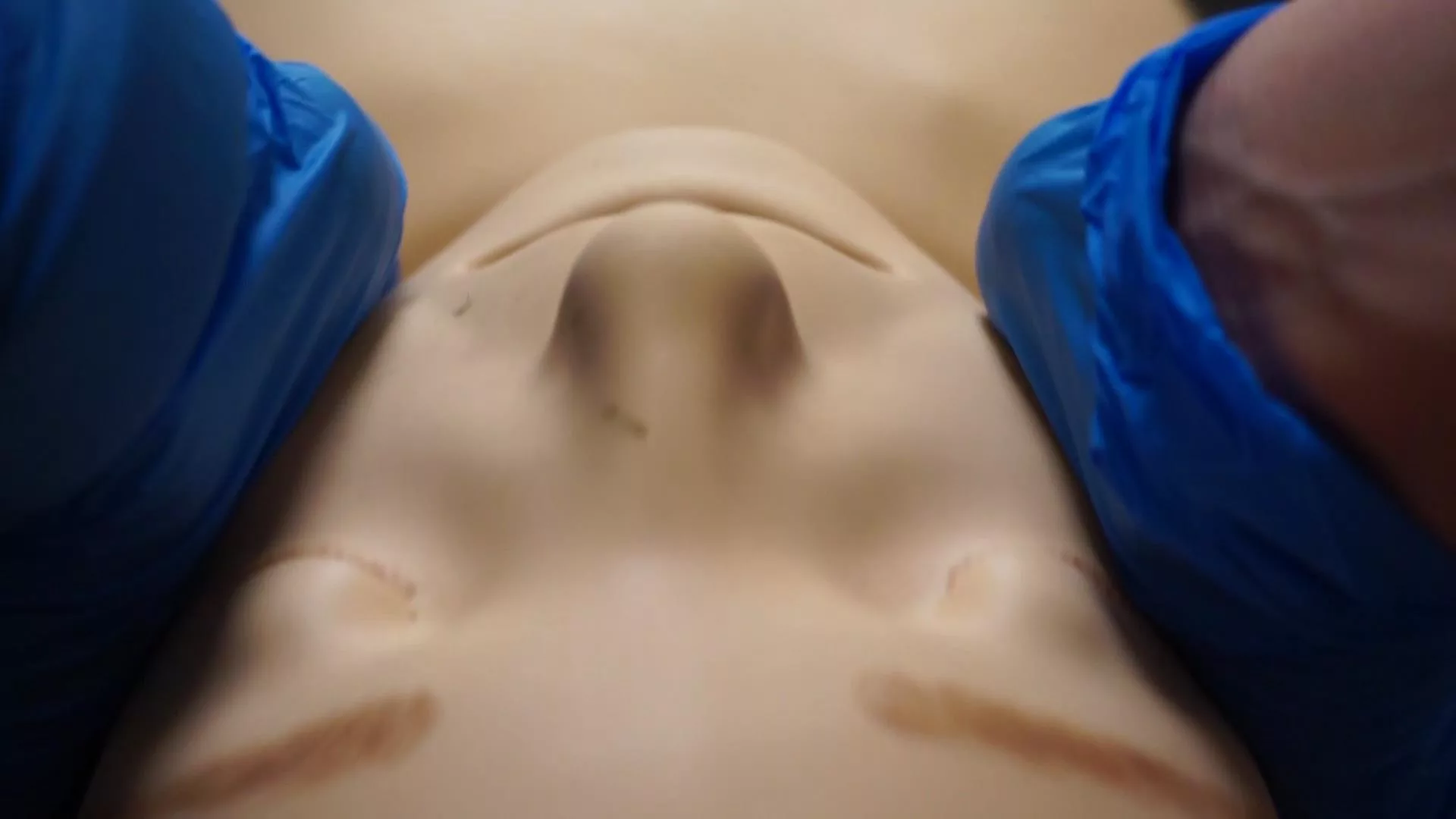
Image above – a person with vitiligo (Source: Adobe Stock) - Shortness of breath (which may also be due to anaemia) – https://www.ncbi.nlm.nih.gov/pmc/articles/PMC2996160/
- Distributive, Cardiogenic, Obstructive + Dissociative shocks (Pilbery & Lethbridge, 2016: 247)
- Including SOB/DIB, PE, pneumothorax, anaphylaxis
- Lung disease, leading to central cyanosis (Douglas et al, 2013: 45) including asthma and COPD (exacerbations & chronic)
- Acute myocardial infarction – https://patient.info/doctor/acute-myocardial-infarction
- Heart failure – https://em.osumc.edu/education/journalClub/SignsandSymptomsofHeartFailure.pdf
- Shock, caused by hypotension – https://www.nhlbi.nih.gov/health-topics/hypotension
- Vasovagal – ‘Facial pallor is often the first sign of an impending vasovagal faint’. https://academic.oup.com/brain/article/132/10/2630/329792>
- Shock – hypovolaemia – https://artifactsjournal.missouri.edu/2016/04/hypovolemic-shock-and-fluid-resuscitation/
- Lingual Raynaud Phenomenon – leading to a white tongue, temporarily – http://www.cmaj.ca/content/188/15/E396
- Drugs – Amiodarone can cause a ‘bluish-grey’ skin discoloration (Douglas et al, 2013: 44)
- Vitiligo (segmental and non-segmental) due to the lack of melanin, causes ‘pale patches of skin’ (Douglas et al, 2013: 46); non-segmental vitiligo ‘is thought to be an autoimmune condition’ (NHS – Vitiligo)
- Albinism (Douglas et al, 2013: 46)
Discoloration of the hands/nails/eyelids:
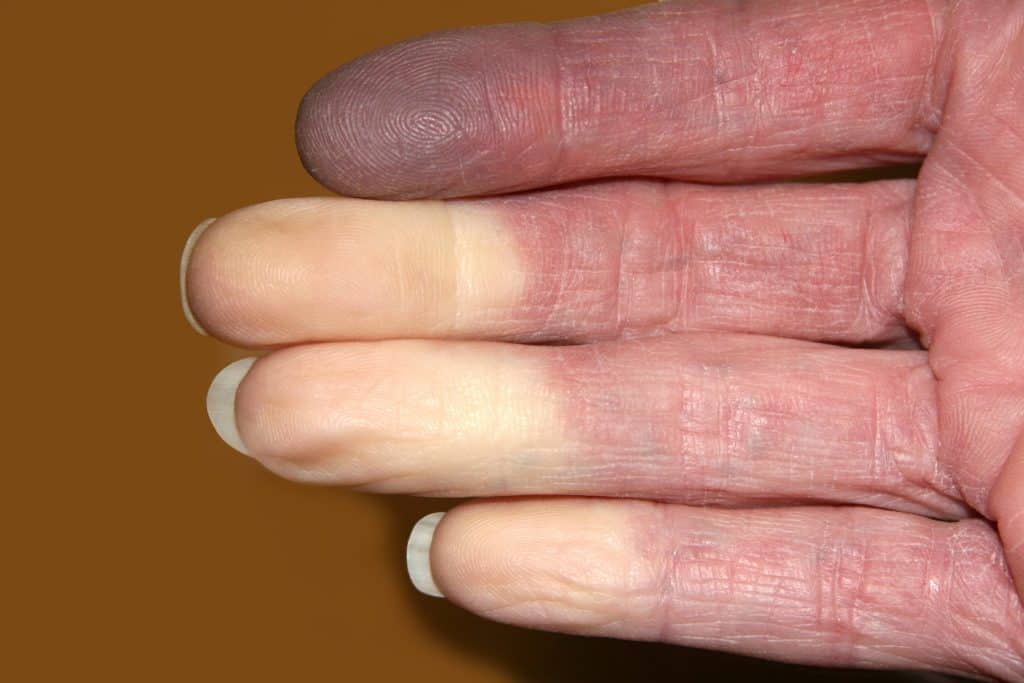
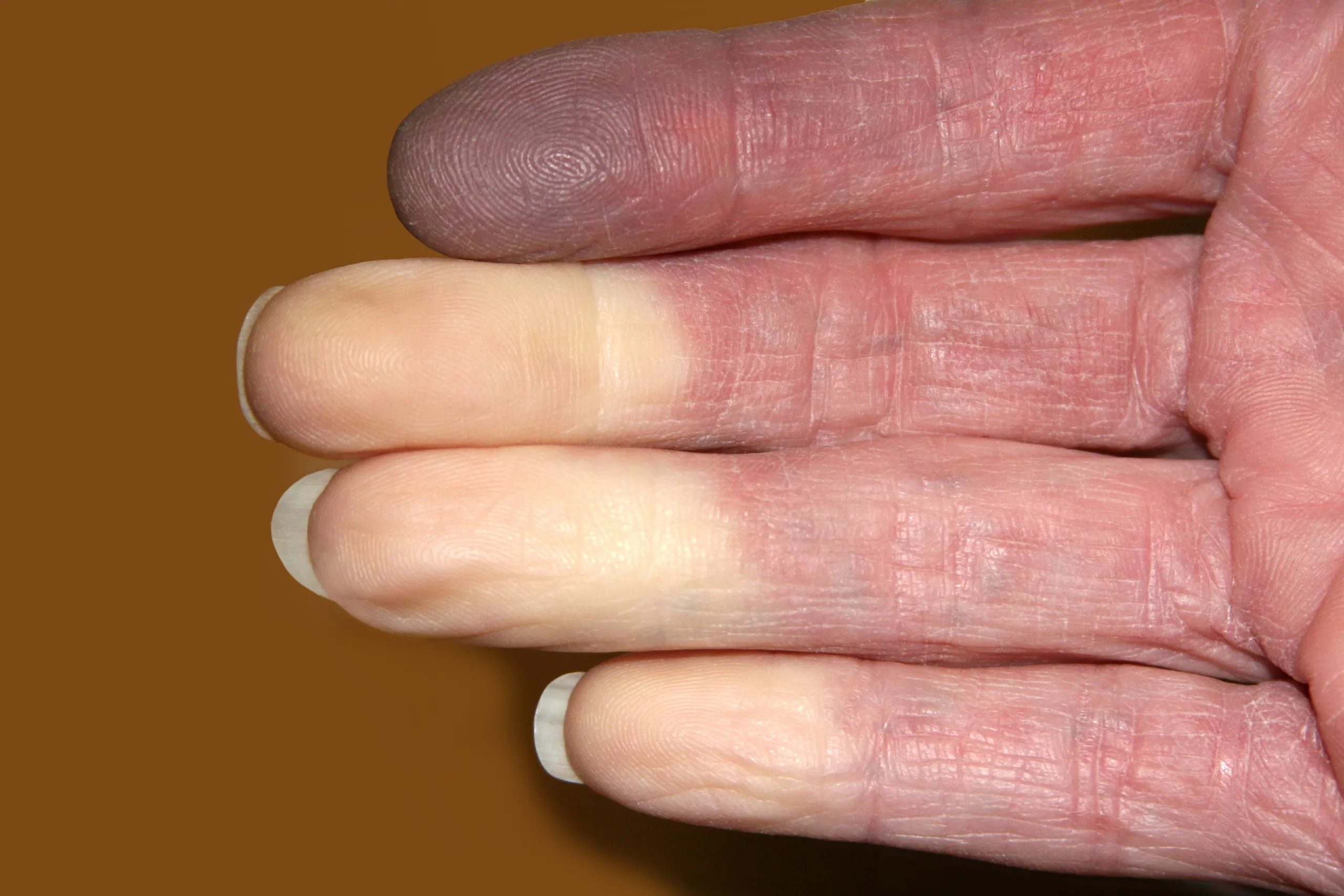
Photo above demonstrates reynauds (Source: Adobe Stock) 13. White discoloration of nails – 6 of 155 HIV patients in a 1998 study had this, amongst other more prevalent changes of their nails – https://jamanetwork.com/journals/jamadermatology/fullarticle/189490
14. Anaemia – ‘pallor of the conjunctiva, palm, nail beds or at any site was associated with a significantly lower hemoglobin concentration’ – From <https://academic.oup.com/jn/article/129/9/1675/4721973>
15. Raynaud Phenomenon – leading to white/yellow/purple fingers, temporarily – http://www.cmaj.ca/content/188/15/E396
Red herring
16. Rigor mortis and liver mortis in an alive patient who was suffering from a dissecting abdominal aorta: https://content.sciendo.com/view/journals/sjfs/22/1/article-p11.xml
Have I missed any? Add in the comments below —>
-

Article 999 Founder Published in Paramedic INSIGHT Magazine, Sep 2022: Functional Neurological Disorder – A Patient’s Experiences; A Paramedic’s Perspective
Earlier this year I had the pleasure of speaking with a patient with Functional Neurological Disorder (FND). Ailsa reached out to the College of Paramedics after experiencing an unsettling mixture of treatment by healthcare professionals in a variety of settings. She hopes to encourage healthcare clinicians to learn more about her condition, a functional neurological disorder. Our understanding of this group of conditions is currently being reshaped, so I agree it is another area in which we must stay up-to-date.
The publication of this post on Article 999 comes at a timely moment as just two days ago I read here that a study published in Epilepsy and Behaviour has documented MRI changes in patients with functional seizures. This furthers the point that what science and medicine thought it knew about this – and perhaps other conditions – while not fiction, is also not yet fact.
Members of the College of Paramedics can read the published article in last month’s issue of Paramedic INSIGHT or online here.
-

Short Skills Video – What Happens When We Squeeze the BVM too Hard and Fast?
Full reference available at Article 999’s reference library here: https://airtable.com/appaQWBYHEs4Y6RjF/tblatVkrBMGBMdpRM/viwMSEJkOai9GwYS4/recFg1GuvEjKQZN9f?blocks=hide
-

Acute Diarrhoea in the Elderly – The Risk Factors
Sign, symptom, or condition Sign of, and Treatment Reference Sunken eyes Dehydration; Patient may need referral to Doctor or urgent rehydration, depending on severity. Patient may benefit from blood tests Johnson and Smith, 2012: 94. High NEWS2 Score Sepsis; patient may need antibiotics and emergency treatment Royal College of Physicians, 2017 Covid-19 The diarrhoea could be a sign of deterioration, but the evidence for this is weak Amico et al, 2020 Female and increased age Increased risk of dehydration Rowat et al, cited in Sweetser, 2012 Heart or kidney failure; take steroids Increased risk of overhydration; patient may require emergency treatment Sweetser, 2012; WHO, 2021. Dizziness Dehydration; patient may require urgent rehydration Sweetser, 2012; WHO, 2021 Confusion; seizures Dehydration or overhydration; electrolyte imbalances; patient may require emergency treatment and urgent rehydration Sweetser, 2012; WHO, 2021 Type 2 Diabetes; metformin Metformin can cause the symptoms; diabetes is a risk factor due to potential difficulties managing the condition Johnson and Smith, 2012: 96 Immunosuppressed Risk of deterioration Johnson and Smith, 2012: 96 Bowel disease such as ulcerative colitis or diverticulitis May indicate more severe illness Johnson and Smith, 2012: 96 Blood in stools May be an indication of abdominal bleeding Johnson and Smith, 2012: 96 -

Recommended Content: Cardiac Action Potential, Explained with Dominoes
If you, like me, struggle to understand the action potential, here is a great video from UBC Medicine, which explains the concept with dominoes. Check it out below.
Credits: UBC Medicine -

CPD Templates v1.4: A Video Walkthrough and Printing Guide
As is the style of Article 999, here’s a video guide to the CPD templates.
Note: This relates to v1.4. If the template you’re using doesn’t have a version number, look out for info on how to make these changes or send me a message or an email, and I’ll help you update your portfolio to the latest version.
Update: The current version (Aug 2022) is v1.5. Look out for a new video walkthrough soon.
-
Interpreting the Acid-Base Balance Using Tic Tac Toe (0s and Xs)
This information is taken from an excellent video by Radiometer, shown here:
Put Simply:
To interpret the acid-base blood gas results, you first need to know what normal levels are – and be careful, because there are international variations in what units we use, and you may also find slight variations in results. You also need to know what a high figure means vs a low figure – is this acidemia, or alkalemia? Let’s help you out:
Your normal levels are:
Ph = 7.35-7.45
Pc02 = 4.7-6.0 kPa
Hc03 = 22-26 mmol L
Which way is acid, and which way is alkaline?

You might notice that respiratory acidosis and respiratory alkalosis are in bold. That is to highlight the fact that these are opposite to the other parameters – a high pC02 = acidotic. A low pC02 – alkalosis. One simple way to remember this is to try to spell ‘opp’ (opposite) backwards, using the other parameters. To enable you to do this, you’re only allowed to swap one C for a P. Go ahead, try it.
For pH, you obviously can’t do this.
For HC03, you still can’t: Even if you change the C to a P, you still have an H in the way.
For pc02, you can swap the C for a P and you can spell: 0PP backwards… That’s the parameter that is opposite to the others!
How to Use Tic-Tac-Toe (0s and Xs)
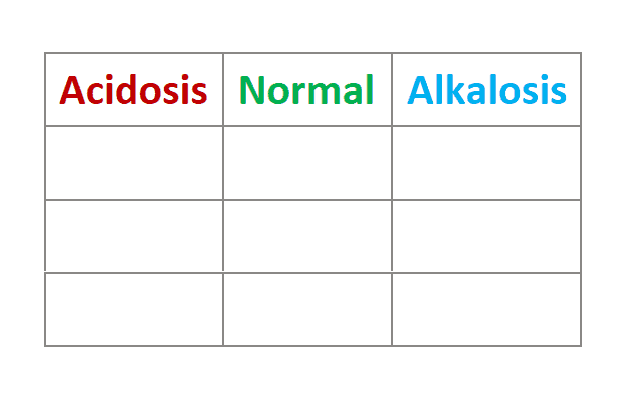
First, draw a tic-tac-toe table like so.
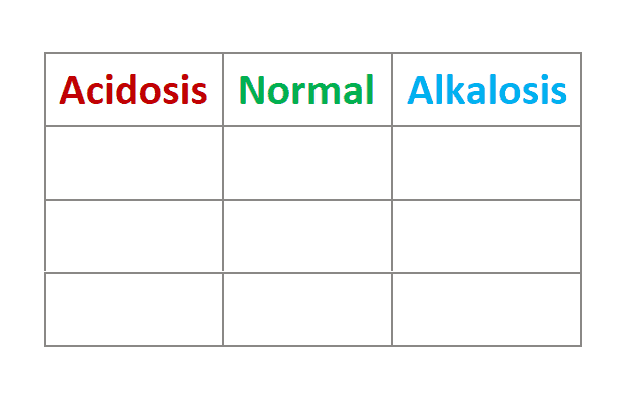
Next, put your pH into the acidosis, normal, or alkalosis column:
Acidosis Normal Alkalosis pH 7.12 Next, put your HC03 or pC02 into the corresponding column. In this case, it’s the pC02:
Acidosis Normal Alkalosis pH 7.12 pC02 13.9 It only takes 3 in a row for tic-tac-toe, and that includes the title, so you have an acidosis here. Because we are looking at the respiratory component (pC02), this is a respiratory acidosis.
But we keep looking because we want to know if the body is trying to compensate. If it is, the opposite component – in this case, the metabolic component, HC03 – will be going in the opposite direction to the general trend. In this case, the general trend is respiratory acidosis, so we’re looking to see if the metabolic component is alkalotic. If there is no compensation, it will be in the normal range.
Acidosis Normal Alkalosis pH 7.12 pC02 12 HC03 33 And it’s above the reference range, so there is partial compensation here. But it’s only partial compensation because the pH isn’t normal.
Acidosis Normal Alkalosis pH 7.36 pC02 11 HC03 33 This is now fully compensated. We know it was probably respiratory acidosis before because a) we have the luxury of repeat blood gas results, and b) the pH is only just normal; in fact, it’s heading towards acidosis. We need to keep monitoring to see if this continues to normalise or if it heads in the wrong direction.
You can use tic-tac-toe to identify respiratory or metabolic alkalosis or acidosis, mixed alkaloses/acidoses, and partial and full compensation. Don’t forget to look at other parameters as well though – more on those soon.
References
For this post, the video above, and:
Thompson, D. A. 2007. Blood Gases Made Simple, Easy, and Quick. Lulu Press.
-

On-Water Rescue Breaths for Divers – Worth it?
For clarity, the term ‘in-water rescue breaths’ has been replaced with ‘on-water rescue breaths’ as these are given on the water surface.
Drowning Vs Diving
When we talk about the diving casualty, we don’t just mean a drowned patient. Any drowned patient may have some other medical cause to explain why they drowned in the first place – a cardiac or neurological cause, for example – and the same is true for the diving patient. But in diving, we may not mean drowned at all, not in the traditional sense. If a patient has managed to keep their regulator in for the entire ascent, and that regulator is working properly, have they drowned? Or is the bigger issue the subsequent decompression illness from not breathing on ascent, and immersion pulmonary oedema?
Let’s have a look at the guidelines for the management of a drowned casualty.
UK Guidelines and First Aid
Most first-aiders will know the drowning protocol:
- 5 initial rescue breaths
- 30:2 CPR
In the 2021 UK Resus Council guidelines, this hasn’t changed, but there is a bullet point that reads:
Start resuscitation as soon as safe and practical to do so. If trained and able this might include initiating ventilations whilst still in the water or providing ventilations and chest compressions on a boat.
Start resuscitation by giving 5 rescue breaths / ventilations using 100% inspired oxygen if available.
Deakin et al (2021)
European Guidelines
What’s interesting is when you then look at the European Resus Council Guidelines 2021. Here, you’ll find much more detail under the drowning section, including the background research that has informed the guidelines. Of note, there is ‘limited evidence […] to inform the treatment of the drowning victim’ (Lott et al, 2021: 197). Despite this, a table of research includes evidence on in-water resuscitation. Four main points are raised:
- Rescue breaths ‘by highly trained rescue teams with water rescue equipment is feasible’
- These breaths should be given for ‘up to 1 min’ (emphasis added) (10 breaths) ‘before attempting transfer to land’
- No further rescue breaths should be given before landing the patient on land or on the boat
- If a rescuer is alone and has no rescue equipment, they should not begin rescue breaths and should instead tow ‘directly to the shore’ or boat (emphasis added).
(Lott et al, 2021: 199).

Why 10 breaths? This should equate to one every 6 seconds, which is exactly what we would do during continuous CPR with an advanced airway, or during ventilation-only CPR in respiratory arrest (Newell, Grier, & Soar, 2018). (However, this paper highlights the potential for increased survival after 30:2 versus continuous CPR).
Note the difference in wording between the 2015 guidelines (below) and the 2021 guidelines (above):
If a rescuer, in general a surf-lifeguard, finds a non-responding drowning victim in deep open water, the rescuer may start ventilation when trained to do so before moving the victim to dry land or rescue craft. Some victims may respond to this.
Truhlář et al. (2015).The 2015 guidelines leaned more towards in-water ventilations than the 2021 guidelines do. The wording was perhaps vague, and left the decision up to the rescuer for when to start ventilations and how long to perform them for, unless the patient was not responding to initial ventilations. In this case, the guidelines emphasised towing the patient to the boat or shore – if it was near – without further ventilations.
The 2021 guidelines, though clearer, do not detail what defines water rescue equipment, or what defines highly trained. Do rescue divers, who are trained at BLS level, constitute ‘highly trained’? Do lifeguards, who frequently practice water rescue, count as highly trained? Or is this term reserved for only ALS-trained healthcare professionals who are also trained in water rescue, or at minimum ILS-trained rescue divers? When we talk about rescue equipment do we mean use of bag-valve-masks and airway adjuncts? Does water rescue equipment include a BCD that is inflated? Translating this advice into diving medical advice is not easy.
British Sub-Aqua Club Guidelines – What Might Change?
BSAC provide dive rescue courses and teach on-water rescue breaths (Cumming, 2011: 56-57), however this information has yet to be updated to the 2021 Resus Council guidelines, and it will be interesting to see what changes when it is updated. The referenced book recommends ventilations while towing, which was not a feature of the 2015 ERC guidelines and makes this book less reliable as a source of information. On the contrary, their Sports Diver student guide (BSAC, 2020: 47), has been updated to stop the practice of giving rescue breaths while towing. Perhaps the biggest change in the next issue will be that a lone rescuer may not be advised to start ventilations in the water, unless help is coming to them and BCDs are considered rescue equipment. Rescuers should also be reminded that the Resus Council advise up to one minute of rescue breaths (Lott et al, 2021: 199). One other change that would be good to see would be a friendly reminder to not perform rescue breaths if this would cause a delay in transport and treatment of the patient – an exemption for some treatments that HCPs should be well versed in. An example of where this might apply would be where the time it takes to give rescue breaths is longer than the time it would take to evacuate this patient to the shore or a nearby boat.

UKDMC – Are Times Changing?
This statement from the UKDMC (Edge and Wilmshurst, n.d.) states that there is a higher chance of neurological damage, despite an apparent improvement in survival rates, when on-water resuscitation is performed. Remind anyone of the trial results from something else we do in resus? They also note that even when lifeguards are performing in-water ventilations, the patient aspirates, and the rescuer tires. And this was in a pool… Now imagine waves of salty water lapping over both patient and rescuer. Multiple other issues arise – ventilation may be restricted by diving equipment that covers the chest, rescuers will be unable to assess chest rise and fall due to this equipment, and even those of us who are HCPs won’t have regular practice, especially in the special circumstances of resus of diving patients.
This doesn’t even consider that in the absence of pulse checks (due to wet/dry suits covering the neck), the rescuer is unable to assess respiratory versus cardiac arrest, and may be at risk of confirmation bias – that casualty who was in cardiac arrest when they surfaced, they have a pulse on the boat so we must have got them back, right? Or, that unconscious patient who wasn’t breathing is breathing now, so we saved them – or were they just breathing so shallow that, in amongst the noise of the boats and the waves, and with all that equipment on them, we could not look, or listen, or feel. Realistically, this may be one reason there is limited evidence. It will be interesting to see how diving organisations respond in the future and whether their guidelines continue to change.

References
British Sub-Aqua Club, 2020. Sports Diver: Student Guide. BSAC.
Cumming, B. 2011. Safety and Rescue for Divers, BSAC: Cheshire.
Deakin, C.D. et al (2021) Special Circumstances Guidelines. Available at: https://www.resus.org.uk/library/2021-resuscitation-guidelines/special-circumstances-guidelines (Accessed 11/12/2021).
Edge, C. And Wilmshurst, P. n.d. The Rescue of a Diving Casualty – A Discussion Paper. Available at: https://www.ukdmc.org/wp-content/uploads/2017/04/PW-and-CJE-position-paper-on-diver-rescue.pdf (Accessed 11/12/2021).
Lott, C. et al (2021) ‘European Resuscitation Council Guidelines 2021: Cardiac arrest in special circumstances’, Resuscitation, 161, pp: 152-219. Available at: https://cprguidelines.eu/assets/guidelines/European-Resuscitation-Council-Guidelines-2021-Ca.pdf (Accessed 11/12/2021)
Newell, C. Grier, S. And Soar, J. (2018) ‘Airway and ventilation management during cardiopulmonary resuscitation and after successful resuscitation’, Critical Care, 22(190). doi: https://doi.org/10.1186/s13054-018-2121-y
Truhlář, A. et al (2021) European Resuscitation Council Guidelines for Resuscitation 2015: Section 4. Cardiac arrest in special circumstances. Available at: https://ercguidelines.elsevierresource.com/european-resuscitation-council-guidelines-resuscitation-2015-section-4-cardiac-arrest-special#BSPECIALENVIRONMENTS (Accessed 11/12/2021)