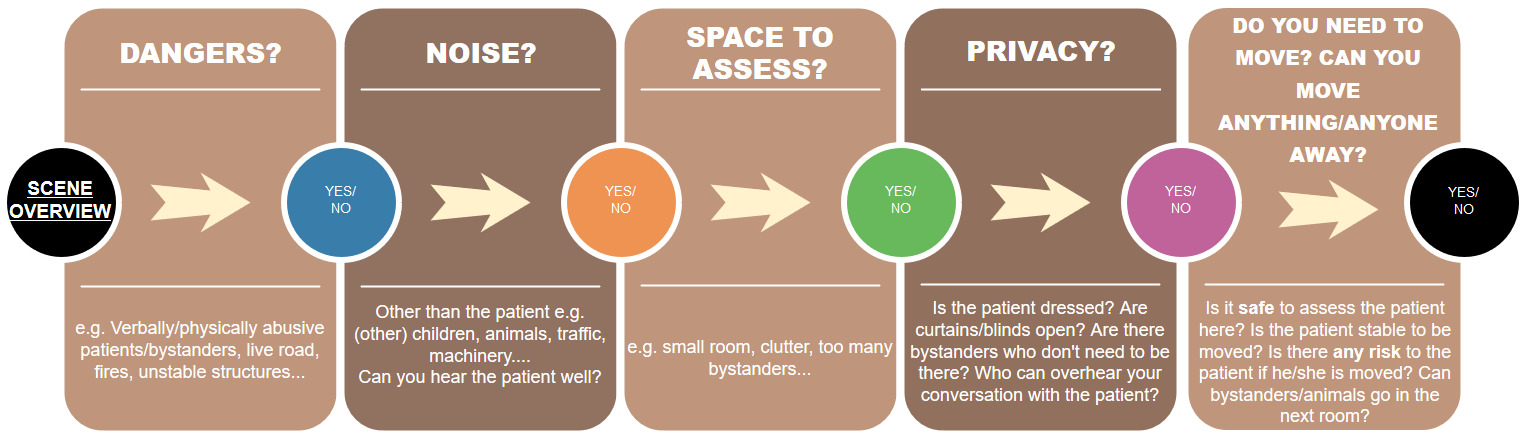
Harris, 2016; Pilbery & Lethbridge, 2016 *This can be made available in alternative formats & colours on request*
And more…
Harris, 2016; Pilbery & Lethbridge, 2016 *This can be made available in alternative formats & colours on request
You may find varying suggestions for what to consider in what is usually referred to as your ‘scene assessment’ (Harris, 2016: 1; Pilbery & Lethbridge, 2016: 126) or ‘end of bed […] assessment’ (Spurr, 2014). This is a cheat sheet to assist you in identifying these important factors. There are a few examples within each category, forming part of what is surely an endless list. Harris (2016: 1-3) also recommends considering use of PPE, considering vehicle position, and considering CBRNE incidents. Pilbery & Lethbridge (2016: 127) recommend considering outside/inside temperature, terrain that is not reachable by land ambulance, and referring to major incident guides where applicable. Major incidents are not covered within this cheat sheet, but this sheet may guide you through the initial thought process prior to announcing a major incident…
Final Note & References
This is a cheat sheet which is designed to complement your scene assessment. This cheat sheet is in the author’s own words but ideas have been used from the below texts. Any copies of the above cheat sheets should be paired with the below references.
Harris, G. 2016. ‘General principles of assessment’ in A.Y. Blaber and G. Harris, ed. 2016. Assessment Skills for Paramedics, 2nd ed. Berkshire: Open University Press, pp. 1-13
Pilbery, R. and Lethbridge, K. 2016. Ambulance Care Practice, Bridgwater: Class Professional Publishing
Spurr, J. 2014. End-of-Bedogram: The Art Formally Known as Intuition, Available Online: http://injectableorange.com/2014/03/end-bedogram-art-formally-known-intuition/ (Accessed 26/03/18)
Feedback? Comments? Please post below…
This post is yet to be peer reviewed. Please get in touch if you have any comments.
This video demonstrates how to insert an OP airway adjunct to an adult patient. A full video, showing how to size & insert the adjunct, along with information about relevant anatomy, is available on our YouTube channel. For more videos like this, stay tuned to www.article999.co.uk as well as the YouTube, Facebook and Twitter pages.
This is the shorter version of the OPA video. For the long version, featuring the when, where and how of OP airway adjuncts, please click here.
All of the content published by Article 999 follows reputable guidelines and are referenced. This video has not been endorsed by any organisation, author or ambulance trust. You must read the full disclaimer available at www.article999.co.uk/about/ (disclaimer tab) before putting into place anything you read or watch here. Please also remember to check your local guidelines before practicing any of these skills.
Transcript
Remember hand hygiene, bare below the elbows, and gloves in real life! (AACE, 2016)
Having opened the airway using manual airway manouvres and checking it is clear of obstruction, and having already selected the appropriate airway adjunct and size, now insert the adjunct back to front (Pilbery & Lethbridge, 2016) with the bendy part, named ‘the body’ (Beattie, 2005), curved towards the patient’s upper lip and nose. Once the adjunct has reached the soft palate, rotate it 180 degrees and advance it (Pilbery & Lethbridge, 2016). It should now rest in the pharynx (Pilbery & Lethbridge, 2016).
Article 999’s own or licenses purchased via Adobe Stock & Dreamstime
Final note.
Why is it so important to size the adjunct? Because ‘If the airway [device] is too long it may occlude the airway by […] displacing the epiglottis; if too short it will not separate the soft palate or tongue from the posterior wall of the pharnyx’
Gregory, P. & Mursell, I. 2010. ‘Airway management’ in Manual of Clinical Paramedic Procedures, Sussex: Blackwell Publishing, pp. 2-34
This post has been peer reviewed by at least one other individual. Let us know what you think in the comments below.
This video demonstrates how to size and insert an OP airway adjunct and points out relevant airway anatomy. A summary, showing OP airway insertion only, is available on our YouTube channel. For more videos like this, stay tuned to www.article999.co.uk as well as the YouTube, Facebook and Twitter pages.
All of the content published by Article 999 follows reputable guidelines and are referenced. This video has not been endorsed by any organisation, author or ambulance trust. You must read the full disclaimer available at www.article999.co.uk/about/ (disclaimer tab) before putting into place anything you read or watch here. Please also remember to check your local guidelines before practicing any of these skills.
Transcript
Remember hand hygiene, bare below the elbows, and gloves in real life! (AACE, 2016)
Airway adjuncts ‘prevent the tongue from partially or completely obstructing the airway’ (Anaesthesia UK, 2010).
The key parts of the upper airway for this video concern the nasal cavity, the oral cavity, the hard palate, the soft palate (at the back of the mouth), the oropharnyx and the pharynx, which is a ‘muscular membranous channel’ (QA International, 2017) that ‘begins at the base of the skull’ and ‘connects the nasal cavities to the […] oesophagus’ (Pazhaniappan, 2017). It is made up of the nasopharynx, oropharynx, and laryngopharynx (Pazhaniappan, 2017). It is also the location a correctly sized OP airway should sit in.
Use an OP airway on ‘an unresponsive patient’ who does not have a gag reflex (Pilbery & Lethbridge, 2016).
Having opened the airway using manual airway manouvres and checking it is clear of obstruction, now size the adjunct (Pilbery & Lethbridge, 2016). OP airways range from size 000 to 5 (AACE, 2016). To find the right size, measure ‘the vertical distance between the patient’s incisors and the angle of the jaw’ (Pilbery & Lethbridge, 2016), as shown. The flange (Beattie, 2005) should align with the lips and ‘the tip to the angle of the jaw’ (Anaesthesia UK, 2017). When correctly fitted, the OP airway should be just big enough to have the flange (Beattie, 2005) resting over the patient’s lips. Now insert the adjunct back to front (Pilbery & Lethbridge, 2016) with the bendy part, named ‘the body’ (Beattie, 2005), curved towards the patient’s upper lip and nose. Once the adjunct has reached the soft palate, rotate it 180 degrees and advance it (Pilbery & Lethbridge, 2016). It should now rest in the pharynx (Pilbery & Lethbridge, 2016).
Association of Ambulance Chief Executives (AACE). 2016. UK Ambulance Services Clinical Practice Guidelines 2016, Bridgwater: Class Professional Publishing
Pilbery, R. and Lethbridge, K. 2016. Ambulance Care Practice, Bridgwater: Class Professional Publishing QA International, 2017. Respiratory System, Available Online: http://visual.merriam-webster.com/hum… (Accessed 22/08/17)
Article 999’s own or licenses purchased via Adobe Stock & Dreamstime
Final note.
Why is it so important to size the adjunct? Because ‘If the airway [device] is too long it may occlude the airway by […] displacing the epiglottis; if too short it will not separate the soft palate or tongue from the posterior wall of the pharnyx’
Gregory, P. & Mursell, I. 2010. ‘Airway management’ in Manual of Clinical Paramedic Procedures, Sussex: Blackwell Publishing, pp. 2-34
This video has been peer reviewed by one or more people. Let us know what you think by commenting below.
Article 999, being a website designed to provide reasonably trustworthy answers to paramedic/EMT questions, along with fast facts and a soon to be launched video library, normally abides by the academic, very legal, I’m-spending-far-too-much-a-month-on-good-design-and-royalty-free-photos, but not today. Today, we bring you an incredibly useful alternative to the Wong-Baker FACES pain scale (Wong-Baker Faces, 2016), the ‘highly unofficial LEGO Pain Assessment Chart’ by Life of Dad (Moles, 2014).
Perhaps otherwise known as a gentle criticism to the Wong-Baker (2016) scale, I thought Article 999’s image collection would go amiss without this attractive alternative:
If you want to find this scale on the go, simply type in Article 999’s search box, FACES, pain scale, or Lego. Go ahead, try it*
*Obviously not endorsed by any organisation. The image’s usefulness is judged by this paramedic alone.
References
Moles, Jason (2014) More Proof that Everything is Better with Lego, Available Online: https://www.lifeofdad.com/more-proof-that-everything-is-better-with-lego/ (Accessed 09/09/2017)