Category: Opinion

  • In Each Corner of Life, We Witness

    In Each Corner of Life, We Witness

    A reflective post.

    Sometimes I forget, so easily, what I’ve seen and who I’ve met, as if all of those experiences have accumulated into one. There is a beauty to this work – a sort of study of the potential of humankind, a sociological survey in a way, a means to observe the route to each eventuality.

    We each explore every inch of our own naivety in the living conditions of every human and their pet, and the desperate circumstances that each person – regardless of their income – finds themselves in when they call 999: from the first cut finger that sends them into a panic, to the teenager whose first meal in days is too late to prevent a syncope. At the same time, we question, moan, degrade the lack of “common sense” in our neighbours. Or perhaps we degrade ourselves – after all, what has our common sense become after excessive exposure to illness and injury? What is our impression of “emergency” after years of practicing urgency in precise circumstances?

    Perhaps, in our roles and years of experience, we have experienced growth upon growth – our pre-existing sensibility has been both nurtured and strained. We never did shout “emergency” for our own minor injuries before. Maybe that is what led us to work in the field we work within: we know to be calm when our legs can still take us to help, or we have adventured into such faraway places that we have had to find calm to find help – or worse, wait for pain to subside and injuries to heal without a polypharmacy. After all, this work attracts certain people who grit teeth rather than scream.

    This work does more than that. It also reminds us that no matter how many days our washing is piling, no matter how long we have waited to clean the dishes, no matter how grubby our carpet, and no matter how strong the stench in the communal hallways, it could always be worse. There are homes in which I have tried tip-toeing (and failed) (you know, the ones that, following your visit, you see reason to stand on the Clinell Wipes you have just neatly placed on the ambulance floor; the ones that make you think, oh, that’s what those little plastic shoe coverings are really for), places in which I have had to wipe my glasses when I step inside, ones in which I have asked if I could open windows (and ones in which windows do not open). There are places in which we have hurried the grab bag back outside to prevent placing it on the infested floor, and ones we’ve immediately asked the patient to step away from.

    Of course, this work has caused more. There are also places of inspiration – places in which I make a mental note of wall colours and furniture, places in which we admire the garden, and ones patients are so proud of they won’t leave, even during fires.

    It’s not all material. There are patients who have proved to me the importance of healthy lifestyles and adaptable homes, ones who are so debilitated by conditions that they creak like an old tree – yet it is the patients much older who repeat endlessly, “never grow old.” Some have a point. Others are so disproven by age-defying marathon runners and glass half-filled storytellers that my empathy is reduced to a mere ‘hmm’ and a raise of my eyebrows.

    The purpose of this blabbering is to remind myself, perhaps all of us, that the route to hospital can be an insightful one, as can the route home on a flight. Sometimes we forget what we see and who we meet. We forget how our paths intertwine, how a few different life circumstances or decisions could have led us to opposing roads. We work (or worked) so intensely, especially overnight, and the “I pay my taxes” or cut finger is too starkly followed by a cardiac arrest (or vice versa). Therefore, to work in this field is to see the juxtaposition of life and have it become normality, to the point we forget how much we have seen, as if it has all become one bubble, which perhaps occasionally we ought to let trickle.

    This is your invitation to realise what you have seen and the characters you have met (ensuring confidentiality) – let the bubble of stories, of life, of potential possibilities trickle out, rather than float into the abyss.

  • If you, like me, have never internalised the whole ‘Hi I See…’/HIS thing for areas of the heart…

    If you, like me, have never internalised the whole ‘Hi I See…’/HIS thing for areas of the heart…

    If you, like me, have never internalised the whole HISS thing for areas of the heart and are fed up with people telling you it’s easy, or to visualise it, STOP trying. Keep it simple. People think this is simple but it is only for them. Instead, think about where you apply the ECG leads. Visualise that.

    V1 and V2 are placed on the sternum. You can think sternum for septal, or ‘high anterior’ (as they are high up on the front of the chest).

    Leads v3 and v4 are placed on the front of the chest. They are anterior.

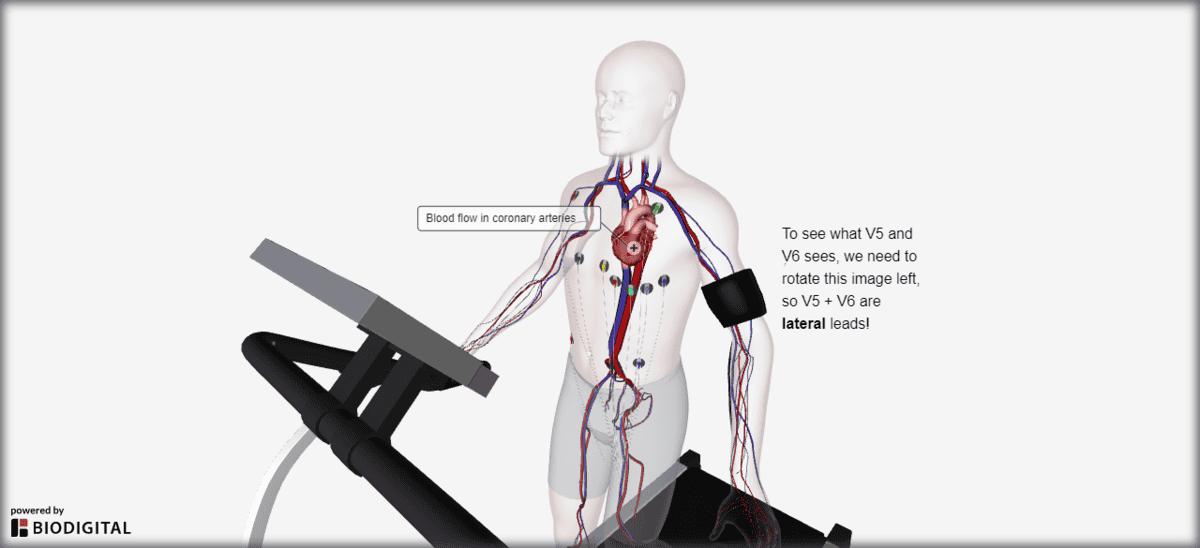
    To see where leads V5 and V6 go, you have to turn an image of the heart to the left. They are lateral leads!

    Try imagining you are the photographer in this 3D image. To see V5 and V6 clearly, you have to be standing on the patient’s left side.

    To remember the limb leads, inFerior is avF, which has two more: ii, and iii. Now all you need to remember is that lateral is I and avL.

    Does it work for you? Let me know. Now to go back and tell my old student paramedic self….

  • Join Us as a Patient Voice on Our Mission to Improve Health Literacy for Patients

    Join Us as a Patient Voice on Our Mission to Improve Health Literacy for Patients

    Why, you ask? Because health literacy levels in this country are shockingly low – seriously, check out this map. Adults in the UK struggle to understand and interpret health information.

    Read about Article 999’s mission to improve this (once there, click on the ‘about Article 999 for patients’ tab).

    Article 999 is posting ‘what to do when’ style posts, tips and useful resources, and we are collating our own collection of resources including charities that offer mentoring. This collection is for you to search and learn and for clinicians to know what is out there to signpost you to. We have also had patient voices, including Alexandra Adams, posting about their health conditions to help others and to inform us from their own voice.

    But we can’t do this alone. Article 999 is in need of patient voices – people who want to write about their experience of their health conditions and when they find they need to call emergency services, and what type of support they wish existed. We also need healthcare professionals including paramedics and physios who are keen to improve health literacy by providing carefully curated content that educates and improves understanding in our patients. Are you interested in these voluntary roles? If so, get in touch by emailing us at article999uk[at]gmail[dot]com. If you are an HCPC registered healthcare professional, remember that contributing to this project will help you achieve your updated HCPC standards of proficiency in relation to health promotion (standard 15.1). If you find it easier to have a certificate to upload as evidence of your contributions, we can provide one for you.

  • Blog: Can Our Patients Access, Feel Confident and Know How to Word their Problems on E-Healthcare Systems? An Opinion Post.

    Blog: Can Our Patients Access, Feel Confident and Know How to Word their Problems on E-Healthcare Systems? An Opinion Post.

    HCPs, how many patients have you met who don’t know that their GPs use online systems for messages and appointments? Patients, if you know about these, do you know how to use them? Patient Access remains a good system, but there is scattered use amongst services – and I don’t think enough people are aware of its existence. The NHS app can place part of its success in forced use resulting from COVID. But the competition in varying patient platforms means that not all GP surgeries make full use of the NHS app. All I can do on it, asides from viewing my GP record of course, is order repeat prescriptions. That, notably, is suitably easy to do on the app. My GP surgery uses the e-consult system, a handy triage and appointment-booking system in one package. But to access it I need to go to my GP surgery website, which seems to change its layout every so often. I then need to find the correct tab, answer some questions that are often unrelated to my complaint but serve to update my GP record, and type something in the box that makes it clear to my GP that I do need their help.

    There are issues here, and these are personal bug-bears:

    • Knowledge, and knowing what to write – A large majority of people do need to be triaged to ensure they are accessing the correct service, but those who have tried various services before, or are contacting their GP at the appropriate time may not know what details the GP really needs. HCPs know that a young, healthy person asking about a cough that has been going on for a few weeks has approached primary care services at the right time compared to a person who has just written ‘cough’ in the field. As frontline clinicians, we are more receptive to an explanation from 111 rather than ‘cough,’ especially as this is likely to be a wrong-service wrong-problem kind of issue. If we as patients think we need a referral for ear problems, we know the GP is likely to realise the importance of our e-consult if we have written that we have already tried x antibiotic and had the problem for some time. For pain, have we already tried pain relief and other self-care solutions? We are more likely to put this in the field and, I would argue (though this is an opinion piece), we are subsequently more likely to have a faster and more appropriate response to our complaint. In my experience of seeing patients frontline, many of our patients would not know what to write. Health literacy rates are poor in this country (Gursul, 2022), and as Jones et al (2022) highlight, e-consult was launched without GP-surgery led implementation (read: training).
    • User confidence – I have many colleagues and friends, from various generations including my own, who are not confident using new systems. I have personally sat with people and coached them on how to use Office software or find system icons settings for their computer. I know many people feel overwhelmed by new systems and some feel overwhelmed by pre-existing systems. Learning their use requires patience and a belief that it is not going to be impossible to learn. Not having either of these leads to frustration. Again, patients have not been shown how to use any systems except, perhaps, the NHS app during COVID lockdowns – and even then that was only if they paid attention to adverts on social media. Our elderly patients are unlikely to see any of this content. Confident use of a system comes with regular use, yet many of our patients are unlikely to use these systems regularly.
    • Access – Some patients do not have smart phones or cannot afford internet access. We cannot find a solution that works for everyone, but we must give everyone the best opportunity to access the options available to them. As the small study (Jones et al, 2022) shows, GP surgery websites do not meet access requirements, and e-consult systems are not easily accessible for all patients. Some patients I have met did not even know these systems existed. GP surgeries need to do better to educate their patients and improve their websites. E-platform creators need to do better to advertise and make their systems accessible. A 2021 study by Bryce et al found awareness of online services in the West Midlands was at 60.8% – however, the authors found this percentage was more likely to consist of patients who used the Internet regularly and regularly saw their GP. That 60.8%, then, are patients who are more comfortable to technology and more exposed to healthcare providers. 60% might be over half, but that still leaves many behind. Patient groups should be on top of issues like this, raising them with their practices and pushing for better practice – but then, is their health literacy and awareness above 40-60% of the UK population? (Gursul, 2022). They must remember that as soon as they engage in health content and have the ability to analyse the information they receive, they are no longer representing the majority. An article by Clarke, Dias, and Wolters (2022) might conclude that ‘non-digital users’ are not ‘disadvantaged’ by online services, as long as traditional services continue, but many patients and HCPs alike will highlight the difficulty produced by large populations accessing GP surgeries by telephone – they are not call centres and cannot handle huge influxes of queries. People might not be disadvantaged, because they can still attempt to access the way they always did access their GP – but they are certainly not advantaged. In my experience some patients say they have not tried to call their GP because they didn’t believe they would get through, or because, as some elderly patients have said, it just isn’t as easy as it used to be.

    In summary, I am suggesting that many patients don’t know what to type in fields that ask about their complaint, and many patients do not know how to use e-systems – even if they know that they exist. And, in a negative health culture, in which people expect to face issues dealing with health services, are people motivated and patient enough to learn these new systems?

    I am not suggesting these systems cease to exist – I personally think they are beneficial, and I like most new technology. However, I do think we need to educate, encourage, support, and mentor our patients to utilise what is on offer.

    HCPs and patients, what do you think?

    References

    Bryce C, et al. 2021. Online and telephone access to general practice: a cross-sectional patient survey. BJGP Open. 2021 Aug 24;5(4):BJGPO.2020.0179. doi: 10.3399/BJGPO.2020.0179. PMID: 33910917; PMCID: PMC8450875. Available at: https://www.ncbi.nlm.nih.gov/pmc/articles/PMC8450875/ (Accessed 28-Dec-2023).

    Clarke, C. Dias, A. and Wolters, A. 2022. Access to and Delivery of General Practice Services. Available at: https://www.health.org.uk/publications/access-to-and-delivery-of-general-practice-services (Accessed 28-Dec-2023).

    Gursul, D. 2022. NIHR Evidence: Health information: are you getting your message across?; June 2022; doi: 10.3310/nihrevidence_51109. Available at: https://evidence.nihr.ac.uk/collection/health-information-are-you-getting-your-message-across/ (Accessed 28-Dec-2023).

    Jones, RB. et al, 2022. Use and usability of GP online services: a mixed-methods sequential study, before and during the COVID-19 pandemic, based on qualitative interviews, analysis of routine eConsult usage and feedback data, and assessment of GP websites in Devon and Cornwall, England. BMJ Open. 7;12(3):e058247. doi: 10.1136/bmjopen-2021-058247. Available at: https://bmjopen.bmj.com/content/12/3/e058247 (Accessed 28-Dec-2023).

    **Opinion post by Article 999 founder

  • To Specialise or Remain General? An Opinion Post.

    To Specialise or Remain General? An Opinion Post.

    This is a discussion I have had with several people recently. I’ve observed the same discussion on social media: Is it better to specialise by taking specific job roles or courses, or to keep up with the ‘jack of all trades’ role of a Paramedic?

    Our profession is at a point of developing specialisms that seem to be staying put. We can now work in primary and urgent care, in research, in palliative care, resuscitation and education roles, or in other community roles such as rapid response. There are ACCP routes popping up around the country. There are resuscitation roles in specialist hospitals, and community roles that focus expertise on specific conditions. I can see a potential future for new staff being one of a few years of general practice, followed by a series of options containing different specialities and of course, different rotas. This is the way other professions have gone and of course, Paramedicine is young compared to the role of a Doctor or Nurse. Perhaps it is only natural for career paths like these to develop over time. It certainly makes for a more interesting, unique career, and it allows us to develop expertise. Specialising also contributes to a clear CV that should help lead to further roles in the area. It could be argued that without emphasising those areas of expertise on our CV, we might stand out less to a potential employer.

    Some argue that remaining general means we never develop expertise in any given area, hence the ‘jack of all trades’ expression that I have heard previously expressed about our profession – we all know how that expression ends. Can anyone be a master of all?

    Many of the roles currently available offer part-time work. I am working in one of these, four days a week. It means the majority of my time is spent with adults, but as I maintain frontline shifts I could still come across paediatrics and maternity jobs. I may specialise in one or two areas, but if this means I do not develop in other areas then I am not being honest with myself: I need more CPD related to those areas I now come across less because I am at risk of deskilling. If I want to develop as a Paramedic then surely I need to develop in all areas of practice.

    My answer to this conundrum is simple: If you do not intend to maintain any frontline work, you do not need to remain general. But if you intend to keep up any of that work, even if this will only be occasional, you must develop in all areas within your remit. You may still specialise and opt for higher level courses in the areas that take up the majority of your time, but it seems sensible to ensure you develop in all the areas you work in. It’s those areas we see the least that will make us the most hesitant. I cannot safely leave my paediatric knowledge behind with what I learned several years ago when I could still see young patients. I cannot stop learning about maternity when those jobs have the potential to be so time-critical. I don’t want to stop focusing on trauma.

    I believe to be the best for our patients, we must juggle all areas. Our expertise is then not necessarily about the courses we have done but the experience we have gained. As I spend the majority of my time working in one or two areas, I could argue those are my specialisms – but I am also still remaining general.

    Share your opinion in the comments below.