Tag: Paramedic

  • Video Guide/Walkthrough to Article 999’s CPD Templates, V1.6

    Video Guide/Walkthrough to Article 999’s CPD Templates, V1.6

    Please note: These videos demonstrate printing/exporting the NQP portfolio. However, all portfolios (post-NQP/Non HCPC/NQP) print in the same way. There is simply more to print in the NQP version. Non NQPs can safely skip parts about printing the NQP learning outcomes.

    Please also note: The settings in the templates are such to enable printing to work properly and to ensure your NQP learning outcomes are in the correct format. Please do not change the settings, unless I have specifically advised that you can. NQPs, please print your learning outcomes from the given table to ensure your portfolio is accepted. If you are unsure, please do reach out.

    For more information, please see the CPD Templates main page, and the Help File.

    The full walkthrough:

    00:00 Intro
    03:40 Logging CPD
    12:50 Editing the Cover Page
    14:00 Editing the Summary of Practice History (and checking the word count)
    14:47 Adding more category/tag options for your CPD log – using the ‘check all fields’ tab (which is *not* for printing.
    17:00 Adding/Editing Development Goals 19: 40 Editing the Statement of How I Have Met the Standards (and checking the word count)
    20:10 Checking, and a second way of logging the NQP Learning Outcomes. Searching for met/not met outcomes as well. Use of the signature(s) column(s).
    23:00 Checking, and a second way of logging HCPC Development Goals.
    24:40 Printing/Exporting
    How to print/export the:
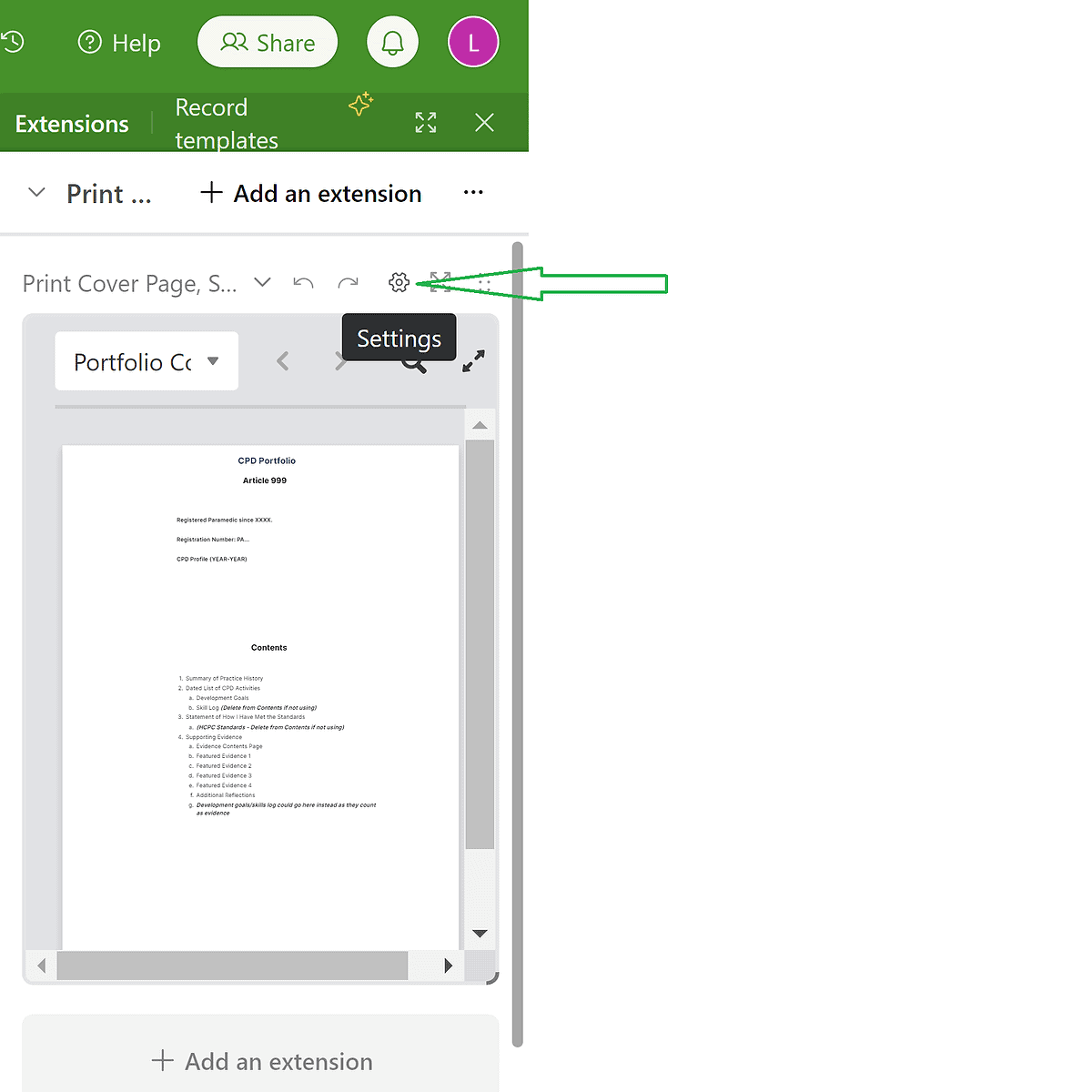
    25:10 Cover Page – Using the extensions tab
    28:20 Summary of Practice History – Using the extensions tab
    29:14 Dated List of CPD Activities – Checking the fields & word count before printing
    32:09 Dated List of CPD Activities – Printing/Exporting the CPD Log
    37:40 Evidence List 39:40 Reflections – Using the Extensions tab
    41:25 Skills
    42:00 Development Goals
    43:00 Statement of How I Have Met the Standards
    44:01 NQP Learning Outcomes
    45:20 HCPC Standards of Proficiency
    46:20 Merging the PDFs, Adding Page Numbers, Editing
    52:06 NQPs or anyone wanting signatures – How to get your portfolio signed electronically.
    54:00 Final bits of advice, references, and support options.

    The printing/exporting instructions only:

    How to print/export the:
    00:00 Cover Page
    03:38 Summary of Practice History
    04:38 Dated List of CPD Activities – Checking the fields & word count before printing
    07:12 Dated List of CPD Activities – Printing/Exporting the CPD Log
    12:45 Evidence List
    15:00 Reflections
    16:50 Skills
    17:25 Development Goals
    18:28 Statement of How I Have Met the Standards
    19:39 NQP Learning Outcomes
    20:45 HCPC Standards of Proficiency
    22:30 Merging the PDFs, Adding Page Numbers, Editing
    27:20 NQPs or anyone wanting signatures – How to get your portfolio signed electronically.
    30:00 Final bits of advice, references, and how to seek support.

  • To Specialise or Remain General? An Opinion Post.

    To Specialise or Remain General? An Opinion Post.

    This is a discussion I have had with several people recently. I’ve observed the same discussion on social media: Is it better to specialise by taking specific job roles or courses, or to keep up with the ‘jack of all trades’ role of a Paramedic?

    Our profession is at a point of developing specialisms that seem to be staying put. We can now work in primary and urgent care, in research, in palliative care, resuscitation and education roles, or in other community roles such as rapid response. There are ACCP routes popping up around the country. There are resuscitation roles in specialist hospitals, and community roles that focus expertise on specific conditions. I can see a potential future for new staff being one of a few years of general practice, followed by a series of options containing different specialities and of course, different rotas. This is the way other professions have gone and of course, Paramedicine is young compared to the role of a Doctor or Nurse. Perhaps it is only natural for career paths like these to develop over time. It certainly makes for a more interesting, unique career, and it allows us to develop expertise. Specialising also contributes to a clear CV that should help lead to further roles in the area. It could be argued that without emphasising those areas of expertise on our CV, we might stand out less to a potential employer.

    Some argue that remaining general means we never develop expertise in any given area, hence the ‘jack of all trades’ expression that I have heard previously expressed about our profession – we all know how that expression ends. Can anyone be a master of all?

    Many of the roles currently available offer part-time work. I am working in one of these, four days a week. It means the majority of my time is spent with adults, but as I maintain frontline shifts I could still come across paediatrics and maternity jobs. I may specialise in one or two areas, but if this means I do not develop in other areas then I am not being honest with myself: I need more CPD related to those areas I now come across less because I am at risk of deskilling. If I want to develop as a Paramedic then surely I need to develop in all areas of practice.

    My answer to this conundrum is simple: If you do not intend to maintain any frontline work, you do not need to remain general. But if you intend to keep up any of that work, even if this will only be occasional, you must develop in all areas within your remit. You may still specialise and opt for higher level courses in the areas that take up the majority of your time, but it seems sensible to ensure you develop in all the areas you work in. It’s those areas we see the least that will make us the most hesitant. I cannot safely leave my paediatric knowledge behind with what I learned several years ago when I could still see young patients. I cannot stop learning about maternity when those jobs have the potential to be so time-critical. I don’t want to stop focusing on trauma.

    I believe to be the best for our patients, we must juggle all areas. Our expertise is then not necessarily about the courses we have done but the experience we have gained. As I spend the majority of my time working in one or two areas, I could argue those are my specialisms – but I am also still remaining general.

    Share your opinion in the comments below.